
Applied Solutions for Circular Systems
Feasibility Studies
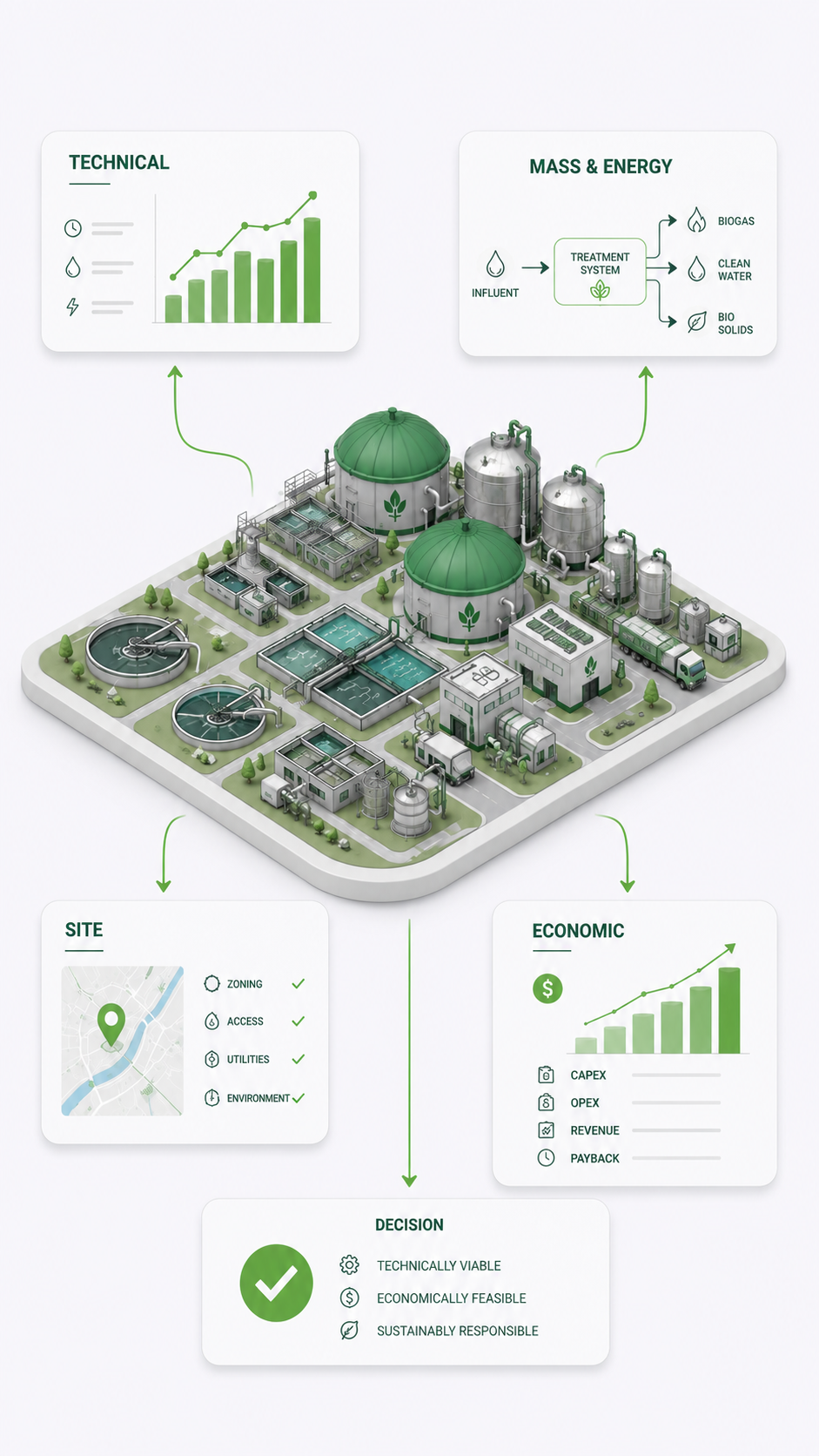
Before investing in a new system or scaling an existing one, it is essential to understand whether it will work technically and economically. Rigorous feasibility studies cover bioresource treatment and recovery, anaerobic digestion, biogas production and resource recovery projects, giving decision-makers a clear, evidence-based path forward.
Feasibility work integrates technical performance analysis, mass and energy balancing, site-specific constraints and economic evaluation to produce actionable recommendations.
Water
utilities
Municipalities
Private
industry
NGOs
Research
institutions
What is ADM1?
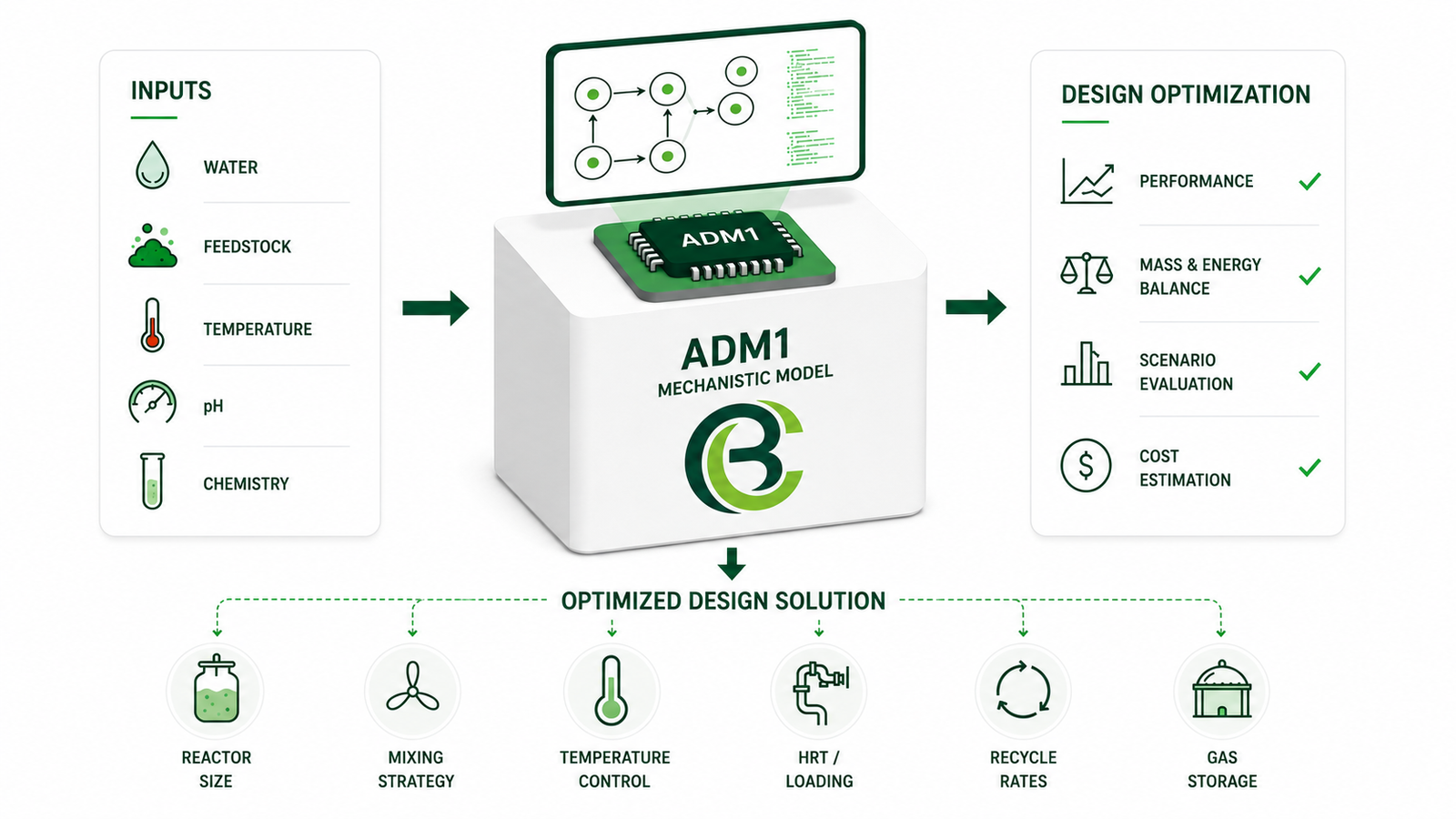
The Anaerobic Digestion Model No. 1 is a structured mechanistic model developed by the IWA Task Group for Mathematical Modelling. It describes the biochemical and physico-chemical processes of anaerobic digestion, making it the gold standard for research and engineering applications.
Process Modeling (ADM1)
Understanding what happens inside an anaerobic digester — and predicting how it will respond to changes — requires sophisticated mathematical modeling. Specialising in the Anaerobic Digestion Model No. 1 (ADM1), the internationally recognized mechanistic model for simulating complex biological conversion processes in anaerobic environments.
Process modelling helps clients optimize reactor performance, troubleshoot instabilities, evaluate new feedstocks, and design systems with confidence before committing capital.
Water
utilities
Private
industry
Agri-food
industry
Research
institutions
Resource Recovery & Biogas Upgrading
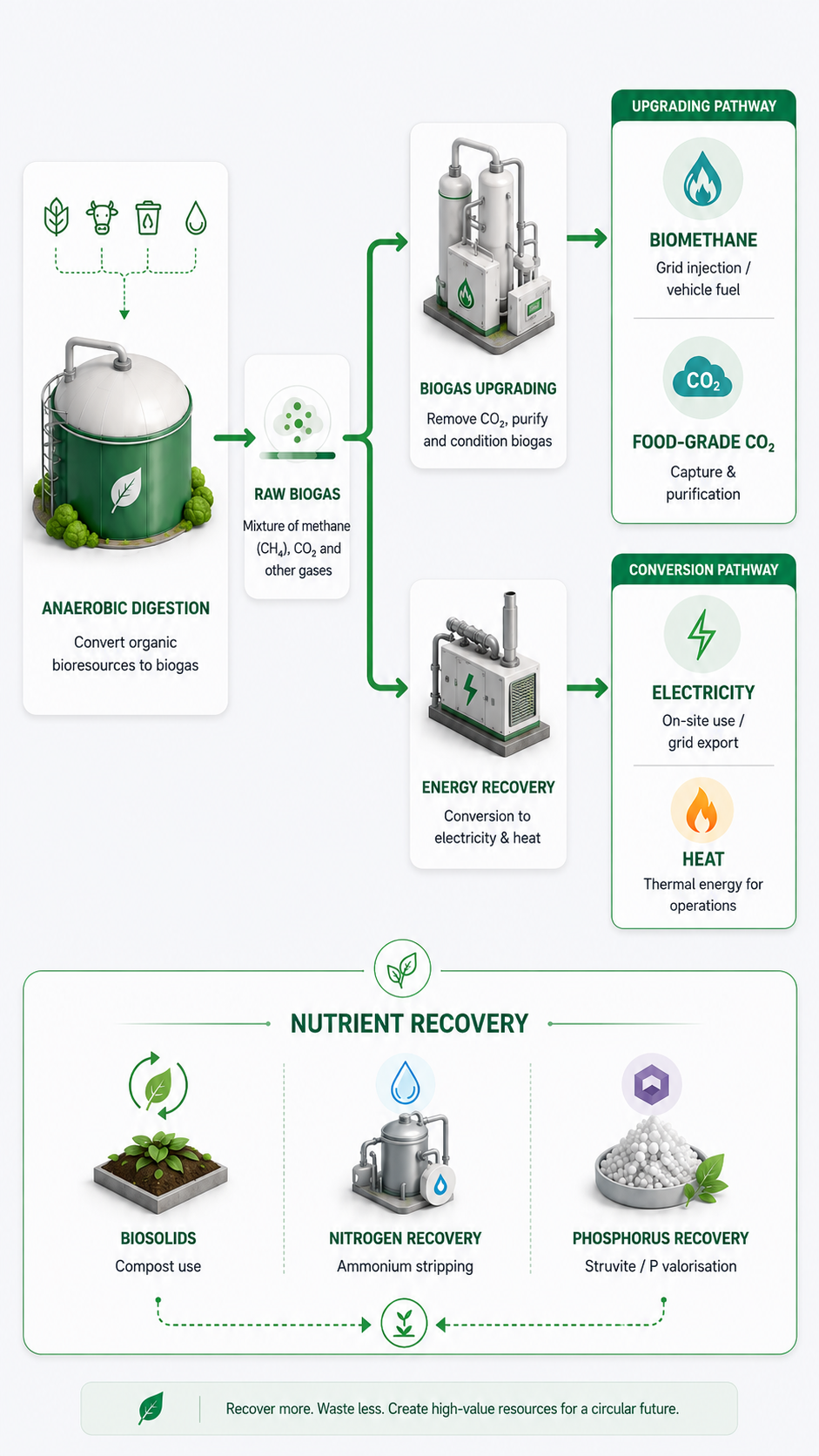
Organic bioresource streams are not just a management challenge. They are a biorefinery waiting to be activated. Carbon, energy, nitrogen and phosphorus are all present and recoverable. Expert consulting spans the full bioresource recovery spectrum, from closing the carbon cycle and recovering nutrients to upgrading biogas into high value products such as biomethane and food grade CO₂. This helps clients operate every treatment system as a true biorefinery.
Biogas and digestate streams can be upgraded into higher value outputs instead of being treated only as by-products. This includes biomethane production, CO₂ recovery, nutrient recovery and carbon reuse through strategies such as ammonium stripping, phosphorus recovery, digestate management and compost application.
Water
utilities
Municipalities
Beverage
industry
Agri-food
industry
Biogas
operators
FAQs
Common questions about engagement models, project structure and technical consulting support.
How can BioResources Consulting be engaged?
Engagements can be structured on a project-based, retainer or advisory basis, depending on the scope, timeline and level of support required.
What is a project-based engagement?
A defined scope with clear deliverables and timeline for a specific challenge, such as a feasibility study, process design or technical assessment.
When does a retainer or advisory model make sense?
This model is suitable for organisations that need ongoing technical support, strategic guidance or regular expert input over time.
Can existing plans or reports be reviewed independently?
Yes. Technical reviews provide an independent expert assessment of plans, reports, proposals or project concepts to support quality assurance and stakeholder confidence.
Still have questions?
Discuss the project, challenge or technical uncertainty directly and identify the best next step.